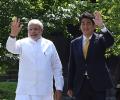
Although the India-Japan relationship has its own driving forces in terms of robust economic ties and shared values, China is the elephant in the room in the strategic parleys between the two countries, says Rup Narayan Das.

The BRICS summit offers Modi an excellent platform to reach out to world leaders and conduct diplomacy on the very ticklish issue of reform of the world governance structure, and to exchange notes with his peers on international, regional and bilateral issues on the margins of the meeting, says Rup Narayan Das.

As the context of Panchsheel has changed, it is all the more essential that India and China need to reinvent and redefine Panchsheel for a new world order taking into account globalisation, and mutual economic interdependence. The new Panchsheel, in order to be relevant, needs to shed its binary approach of west verses the east recognising the seamlessness of global frontiers, which globalisation has brought in, says Rup Narayan Das.
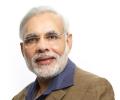
The major driver of Mod's foreign policy can be gauged from his economic priorities such as creating employment opportunities for the youth bulge. Related to this is emphasis on manufacturing, and infrastructure development, which in turn raises the issue of FDI. He has already articulated his views on all these issues, says Rup Narayan Das.

'After more than 20 years of understanding, nothing much seems to have been achieved. What the two countries have been trying to do is to manage the recurrence of border incursions. The two sides must address the disease, and not the symptom of the disease,' says Rup Narayan Das.

The visit of Park Geun-Hye to India, though a symbolic one, will certainly give a further impetus to the strategic partnership between the two countries says Rup Narayan Das.
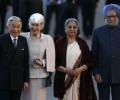
In recent years India-Japan relations have acquired rich economic content and strategic intents. Although the bilateral trade at $18 billion between the two countries is not very impressive and leaves much to be desired, the economic engagement between the two countries is both qualitatively and quantitatively noteworthy. India-Japan defence cooperation, however, has generated a lot interest among the strategic community in the context of rise of China. There has been a lot of speculation about India-Japan strategic partnership to hedge China, says Rup Narayan Das.

India-Vietnam relationship has its own imperatives and dynamism. In India's look east policy Vietnam has been the major pivot, at least in terms of security and strategic imperatives, says Rup Narayan Das.

In spite of irritants and hiccups in the relationship, a few deliverables are expected of the prime minister's visit to China, says Rup Narayan Das.

The Border Defence Cooperation Agreement with China needs closer scrutiny, says Rup Narayan Das.

The present crisis in the Korea is an opportunity for India to thoughtfully engage in the region, and not to be a mere spectator. India enjoys a great degree of credibility by all the stakeholders in the region including the two Koreas, and China and as such India should play its persuasive role for peace and stability in the region, says Rup Narayan Das.

As the two democracies India and the US-- come closer, increased parliamentary exchanges will help consolidate the relationship, says Rup Narayan Das.
India's respectability in the world, particularly the west, lies in its steadfast adherence to ideas and ideals for democracy such as the rule of law, freedom of press, judicial activism and the vibrant civil society -- unlike China, says Rup Narayan Das
If China, inspite of the US supplying arms to Taiwan, its adversary, can calibrate a relationship of mutual inter-dependence with the US, why can't New Delhi manage its relationship with China? asks Rup Narayan Das.
'It is time India calibrated a policy of what Indira Gandhi called equi-proximity rather than equi-distance between the US and Russia.'
Unlike Indo-Pak talks, which are equally sensitive, India-China border talks have been low-key without arousing any kind of unrealistic optimism or expectation. Talks have been slow, but steady, without meeting any roadblock. This is symbolic of maturing of relationship between the two countries which has been achieved over the years.
Sharma has to be a catalyst working like an honest broker pleading for the interest of the developing countries of the Afro-Asian region with the developed West. He has to tread cautiously carrying with him the goodwill of both the developed countries and that of the developing countries.
